

Polycystic ovary syndrome (PCOS)

A hormonal disorder causing enlarged ovaries with small cysts on the outer edges.

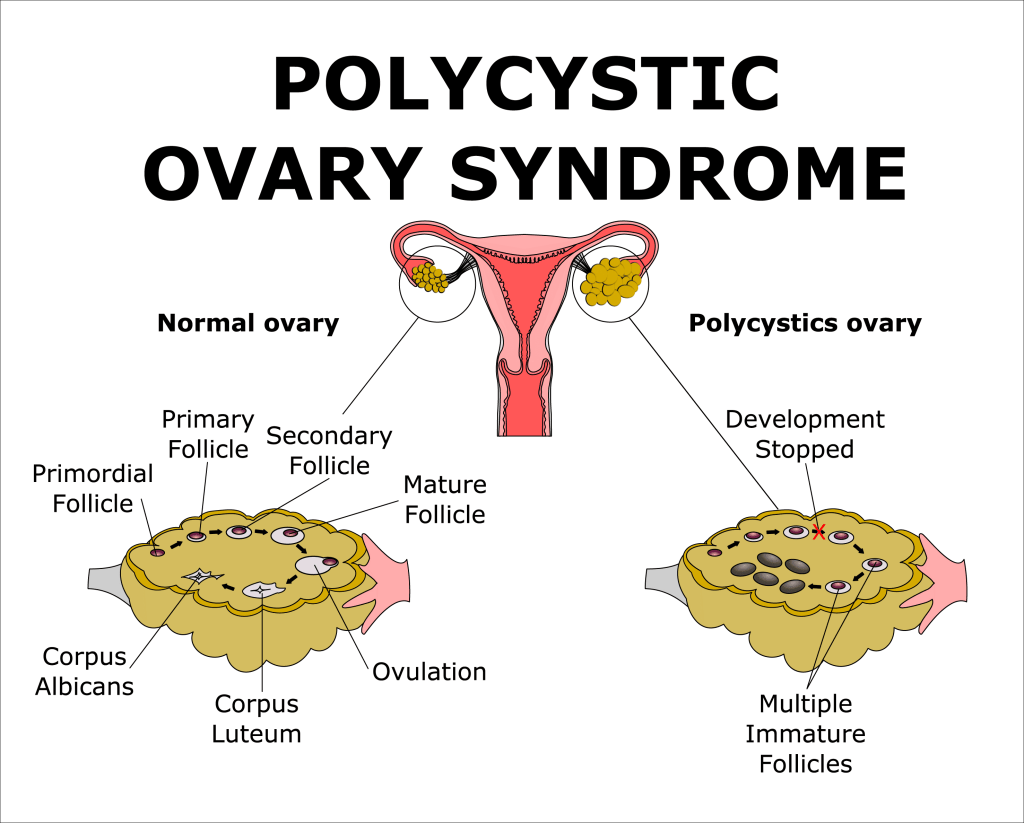
The cause of polycystic ovary syndrome isn’t well understood, but may involve a combination of genetic and environmental factors. Polycystic ovary syndrome (PCOS) is a hormonal disorder common among women of reproductive age. Women with PCOS may have infrequent or prolonged menstrual periods or excess male hormone (androgen) levels. The ovaries may develop numerous small collections of fluid (follicles) and fail to regularly release eggs.

Way to examine polycystic ovary syndrome :-

A pelvic exam. The doctor may visually and manually inspects your reproductive organs for masses, growths or other abnormalities.

Blood tests. Your blood may be analysed to measure hormone levels. This testing can exclude possible causes of menstrual abnormalities or androgen excess that mimics PCOS. You might have additional blood testing to measure glucose tolerance and fasting cholesterol and triglyceride levels.
An ultrasound. Your doctor checks the appearance of your ovaries and the thickness of the lining of your uterus. A wandlike device transducer is placed in your vagina (transvaginal ultrasound). The transducer emits sound waves that are translated into images on a computer screen.

The 3 main features of PCOS are Or symptoms for PCOS:-

  • Irregular periods – which means your ovaries do not regularly release eggs (ovulation)
  • Excess androgen – high levels of “male” hormones in your body, which may cause physical signs such as excess facial or body hair
  • Polycystic ovaries – your ovaries become enlarged and contain many fluid-filled sacs (follicles) that surround the eggs (but despite the name, you do not actually have cysts if you have PCOS)

If you have at least 2 of these features, you may be diagnosed with PCOS.

Common signs and symptoms of PCOS include the following:

  • Menstrual disorders: PCOS mostly produces oligomenorrhea (fewer than nine menstrual periods in a year) or amenorrhea (no menstrual periods for three or more consecutive months), but other types of menstrual disorders may also occur.
  • Infertility: This generally results directly from chronic anovulation (lack of ovulation).
  • High levels of masculinizing hormones: Known as hyperandrogenism, the most common signs are acne and hirsutism (male pattern of hair growth, such as on the chin or chest), but it may produce hypermenorrhea (heavy and prolonged menstrual periods), androgenic alopecia (increased hair thinning or diffuse hair loss), or other symptoms. Approximately three-quarters of women with PCOS have evidence of hyperandrogenemia.
  • Metabolic syndrome: This appears as a tendency towards central obesity and other symptoms associated with insulin resistance. Serum insulin, insulin resistance, and homocysteine levels are higher in women with PCOS.
  • PCOS can be a genetic problem that means if your ancestors are dealing with PCOS you may can deal with it.

If are you looking the Best infertility hospital for Infertility treatment in Indore, Mohak Infertility Center is one of the Best fertility hospitals in India and provides world class IVF, IUI, ICSI, Test tube baby and Infertility treatment at very low cost. We  have a highly experienced IVF specialists team at this hospital for infertility treatment. Book an appointment  today call now us 7898047572 / 8085277666 for more information.

Request an Appointment / General Inquiry:- https://www.mohakivf.com/Contact-us.htm

Please go through our social media :

like our page to now more about IVF

Facebook :-https://www.facebook.com/MOHAK-IVF-1167147806785287/

Please do follow on Instagram

Instagram :- https://www.instagram.com/mohak_ivf/

To More Post :- In vitro fertilization
Assisted Reproduction Technologies

This includes a number of special technique which assist infertile couples to have children. Some prominent technique are :-

  1. Test tube baby programme
  2. Gamete intra fallopian tube (GIFT)
  3. Intra cytoplasmic sperm injection (ICSI)
  4. Artificial insemination technique (AIT)

Test tube baby programme :- this method involves in vitro fertilization (IVF) , fertilization of male gamete and female gamete outside the body in almost similar conditions as that in the body followed by zygote Or embryo transfer.

In some women normal conception is not possible because of blocked oviducts Or spermicidal secretions in the vagina pr low sperm count of the males. These are also cases wherein women cannot produce ova or men can’t produce sperm. In such cases, ovum from females is remove surgically after hormonal stimulation of the follicle. It is then fertilized by her donor male sperm in am laboratory dish containing a nutrient broth. The zygote up to eight blastomers is then transferred into fallopian tube or embryo with more than eight blastomers is transferred into the uterus.

The entire operations is carried out under the sterilised conditions.

The baby produced by conceiving in culture dish and nursing in the uterus is called a test tube baby. A scientific term for this procedure is In vitro fertilization.

Success rate of test tube babies :- The success rate of the technique of producing test tube baby is less than 20% . To increase the chance of success, the prospective mother given fertility drug which cause many ovarian follicle to mature at same time. This release many eggs simultaneously, there by increasing the chance of success. The additional embryo are transferred to surrogate mother for competition of development. They can also be frozen for later use.

Surrogate mother : a developing embryo can be inserted in the uterus of another female, provided her hormone are in the proper phases of reproductive cycle for implantation to occur. A woman who substitute or take place of the real mother to nurse the embryo is called as surrogate mother.

Problem in producing test tube baby : the production of test tube baby involving the surrogate mother raises some ethical and legal problem such as right over child.

U. S. Government has proposed the following guidelines :-

  1. No embryo should be left outside the mother.
  2. Only married person should contribute egg and sperm for producing test tube baby.
  3. Cost of embryo transplants in surrogate mother will not be funded by the Federal Government
  1. Gamete Intra Fallopian Transfer (GIFT) :- this method is used in female who can’t produce ova but can provide suitable environment for fertilization and further development of embryo in the oviduct. In such case, ovum from the donor female is surgically removed and is them introduced into the Fallopian tube of such female. Such women then accept sperm from male during copulation.
  1. Intra Cytoplasmic Sperm Injection (ICSI) :- it is another specialized technique to form an embryo in the laboratory in which a sperm is directly injected into the ovum placed in a nutrient broth.
  2. Artificial insemination technique (AIT) :- this technique is used in those female where the husband either is unable to insemination the female or has very low sperm count in the ejaculates. In such case, the semen of the husband is first collected and then is artificial introduced either into the vagina or into the uterus of the female.

All the above mentioned technique require extremely high precision handling by specialized professional and expensive instrumentation.

Such facilities are presently available in all IVF centre.. This may lead to complications such as pelvic inflammatory disease PID, abortion, still birth, ectopic pregnancy, infertility or even cancer of the reproductive tract. Sexually transmitted diseases STD are a major threat to a healthy society Under such programmes., Adolescence are specially targeted to follow some principles given below :

  1. Avoid sex with unknown partner or multiple partner
  2. Always use condoms during coitus
  3. If you doubt for an reproductive infection.., go to doctor immediately.

Are you looking for the best IVF center for infertility treatment in MP according to your budget, then you should visit Mohak Infertility Center in Indore, as Mohak Infertility Center is one of the best IVF Centers in Indore. Mohak Infertility Center is  considered very famous for childless couples for many years, because 97% satisfied infertility patients go back to this hospital. We have a very experienced IVF specialist Dr. Shilpa Bhandari. She is an expert in IVF, IUI, test tube baby,  infertility treatment and ICSI treatment. If you are looking for the best center for IVF in Indore, then book an appointment today with infertility treatment hospital in Indore call  us 7898047572.

Request an Appointment / General Inquiry:- https://www.mohakivf.com/Contact-us.htm

Please go through our social media :

like our page to now more about IVF

Facebook :-  https://www.facebook.com/MOHAK-IVF-1167147806785287/

Please do follow on Instagram

Instagram :-https://www.instagram.com/mohak_ivf/

To More Post :- Embryo freezing: What you need to know